

Everyone outside of enterprise titans is feeling the pain of a global semiconductor shortage. The drought spans everything from high-end workstations to the basic chips in your refrigerator. Between the insatiable hunger of AI data centers and two-year production reservations, the industry is essentially clutching its stomach while reaching for the Pepto-Bismol. Ironically, the solution might be more than metaphorical.
Meet Bismuth
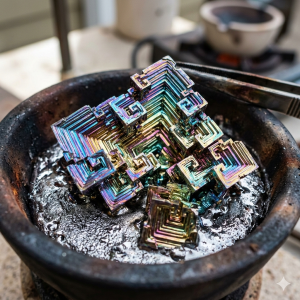
The element with disruptive potential is also the active ingredient in your favorite over-the-counter stomach remedy: specifically, 2D bismuth oxyselenide (Bi2O2Se). While you won’t find this specific semiconductor grade in your medicine cabinet, there are compelling reasons you will want it in your future devices. Researchers have successfully transformed bismuth into a material that could—at the very least—supplement the current chip drought. More broadly, substantial evidence suggests this crystal could become the new paradigm in computing.
This “lap dog” tenacity and gold-medalist efficiency start with the ability to arrange bismuth’s atomic structure into transistor pathways just 1–2 molecules thick. This doesn’t just match silicon; it outperforms it. This material offers superior energy flow, faster switching speeds, and greater durability than traditional silicon.
For decades, silicon has been the bedrock of computing. But as we shrink transistors toward the atomic level, we hit a wall. In present-day “process nodes” (the tiny circuits on a chip), silicon becomes electrically “leaky,” allowing electrons to escape their intended pathways. At these scales, even average desktop CPUs are affected by quantum behaviors. When you pair that leakage with silicon’s natural heat generation—caused by electrons physically crashing into silicon atoms—you get the “friction” that makes your phone hot during a 4K video recording.
To stop this “quantum tunneling,” engineers must increase the voltage to the “doors” that keep circuits closed. This works, but it generates even more heat. As circuits shrink, these resistances increase exponentially.
A Positive Disruptor: From Data Centers to Your Den
The “AI-pocalypse” has left home and business users choosing between sky-high pricing and indefinite back-orders. While the silicon market remains critically oversubscribed, Bismuth offers a path forward that isn’t throttled by the same capacity constraints. We expect to see the first specialized bismuth AI accelerators just before the year 2030.
The Prediction
Three logistical factors make Bismuth a smoother pill for the industry to swallow:
- The “Byproduct” Bonus: Unlike silicon’s energy-intensive mining, bismuth is a byproduct of lead and tin mining. We are already doing the work; we just need to catch the “runoff.”
- Geographic Diversity: Bismuth deposits are scattered broadly across China, Vietnam, Mexico, and Japan, reducing reliance on a single region.
- Highly Recyclable: Bismuth melts at a remarkably low 520°F. Reclaiming it from “E-waste” is almost as easy as melting a candle, unlike the high-heat chemical intensity required for silicon.
We know it’s tempting to get really excited for a solution to the silicon shortage, but we want to make sure we balance out the facts. In the spirit of being a killjoy, you should know that because bismuth is a byproduct, its supply is currently tied to worldwide demand for lead. If we stop using lead in other industries, our bismuth “bonus” could get a lot more expensive.
Bismuth in the Market
- Massive Price Spikes:
- Antimony: Prices rose roughly 250% in 2024 and reached record highs near $50,000 per ton by early 2025, roughly 10 times the five-year average.
- Bismuth: Domestic prices in China doubled following export restrictions. International prices hit an all-time high of $77.16 per kg in early 2025—a six-fold increase from the start of the year.
- Stock Performance (Year-to-Date as of March 2026):
- United States Antimony Corporation (UAMY):
- YTD Return: Up approximately 95.6%.
- 1-Year Return: Up a staggering 679% as it remains the primary U.S. play for domestic supply.
- Zhuzhou Smelter Group (China): This major bismuth producer saw its stock rise 24% in a single month (March 2025) as it outperformed the broader market following new export scrutiny.
- United States Antimony Corporation (UAMY):
It’s important to note that other critical market drivers have provided a catalyst for this growth, such as:
- China’s Export Ban: In late 2024 and early 2025, China restricted or banned exports of gallium, germanium, and antimony to the U.S., followed by heightened scrutiny on bismuth.
- Semiconductor & Defense Demand: Both metals are “critical minerals” used in semiconductors and military applications (ammunition, missiles), making them highly sensitive to trade tensions.
- Supply Deficits: Analysts expect a supply gap for antimony to expand to 21,000 tons by 2026 due to surging demand from the photovoltaic (solar) sector.
While China’s export licensing remains a hurdle, the global push for “beyond silicon” materials is no longer a lab curiosity—it’s a multi-billion dollar race.
Disclaimer: This post is for informational purposes only and does not constitute investment advice, solicitation, or an endorsement of any specific security or industry. Market data is provided solely to illustrate the technological potential of bismuth as a successor or supplement to silicon. All investment decisions should be made based on your own due diligence and in consultation with a licensed financial professional. However, if you’d like to talk to us about anything tech’, tap or click here to call us.